
The Dr. Jacobs Serial VectorLift
The purpose of any esthetic treatment, including a facelift, should be to enhance and restore a person’s appearance while creating a natural-looking outcome. Dr. Jacobs’ Serial VectorLift technique achieves a natural result, without the appearance of being stretched or pulled, as can be the case with a traditional facelift. Dr. Jacobs is continually working on developing and perfecting his methods to allow his patients to enjoy beautifully balanced results.
More than a decade ago, Dr. Jacobs decided to look at the human face in an entirely different way. Having a strong interest in both physics and mathematics, he wondered what these disciplines might offer to the world of facial plastic surgery. Could there be a form of cross-pollination that doctors were missing? After all, a precedent has certainly been set with engineering and orthopedic surgery in the design of artificial joints.
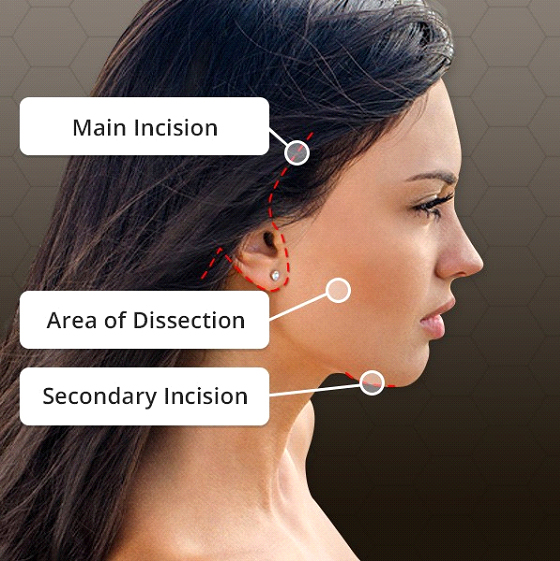
In examining the face, he found that the undulations of the human ear create a perfect setting to camouflage facelift incisions. There are zigs and zags along what he calls the “California coast” where nature has cleverly allowed for no straight lines. In most cases, incisions for facelifts follow this “coastline.” Incisions in front of the ear also allow access to the cheek, jowl, and jawline. The portion of the facelift incision that traverses around the earlobe and behind the ear allows the surgeon to tunnel under the skin to lift and tighten any neck laxity.
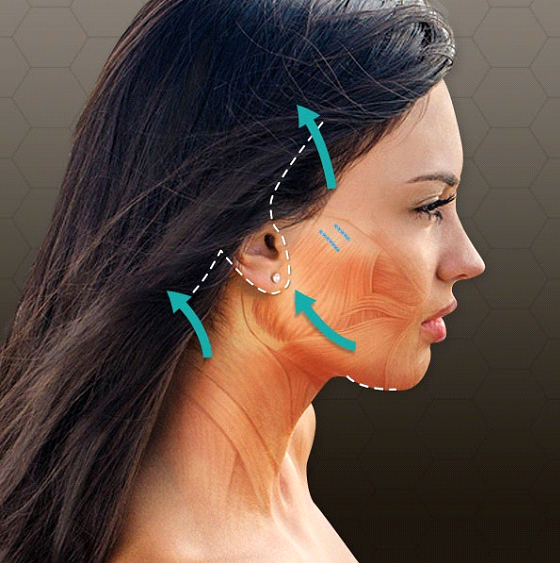
But once the incision is made, surgeons vary tremendously in what they do next for a facelift. Below the skin and its supporting layer of fat lies the fascia. This is a strong layer of connective tissue that has much more tensile strength than skin — especially aged or sun-damaged skin. Many doctors sew this loose fascia (Superficial Musculo-Aponeurotic System, or SMAS) in an upward direction to lift the face. However, lifting the fascia from just in front of the ear doesn’t always yield ideal facelift results. Dr. Jacobs’ Serial VectorLift allows him to restore the tissue to its original place, leaving a natural look.
Surgeons who perform facelift procedures have traditionally been taught to sew the fascia in front of the ear because it’s closest to the point of entry into the face and contains fewer key structures, such as branches of the facial nerve and blood vessels. A facelift surgeon who lacks the advanced skills necessary for a Serial VectorLift will take this simpler approach. Some patients undergoing this old-school facelift technique will see modest improvements, but the results won’t last for more than six to 10 months. In addition, the inefficient nature of this method may lead a surgeon to compensate for the lack of manipulation to the fascia by pulling the skin too much, which leads to the mask-like stretch that appears so unnatural. Most patients agree this looks “overdone.”
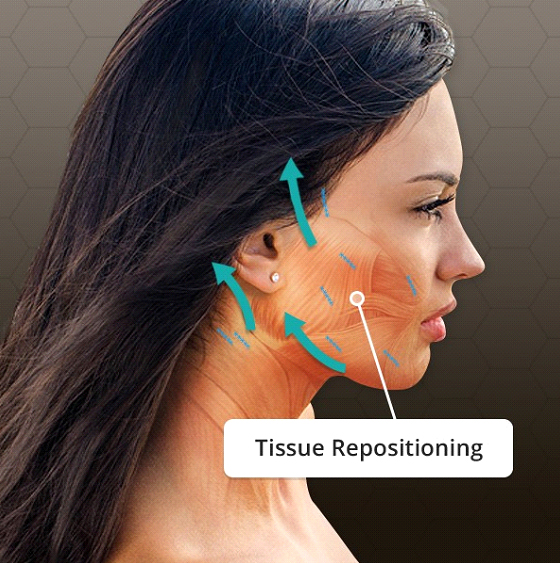
Repositioning the SMAS (Superficial Muscular Aponeurotic System) fascia for a more natural looking result
If a surgeon studies the human face like a physicist, but crafts his scalpel and stitching techniques in combination with an advanced knowledge of anatomy, the results of a facelift are astonishing and beautiful: the Serial VectorLift. Small sutures placed into the SMAS, starting at the jowl, allow Dr. Jacobs to work the proper vectors to lift up toward the ear in a stronger, more balanced way. The position, angle, and number of stitches in a Serial VectorLift will vary from patient to patient and from one side of the face to another. The results from this type of facelift are fuller cheeks, smoother jowls, and a mid-face that’s curved (not stretched flat). Dr. Jacobs knows he has achieved the desired results from his Serial VectorLift when a patient’s face follows these graceful, natural arcs.
Dr. Jacobs has been using this Serial VectorLift technique now for more than seven years. Having performed traditional facelifts for 15 years prior to this, he believes his new approach provides better, longer lasting results. Patients come to him for a facelift to get a more youthful face and less “jowling.” What they don’t expect is a Serial VectorLift that allows for a beautifully contoured cheekbone and a youthful restoration that we believe is unparalleled in facelift surgery today.
Learn more about Dr. Jacobs' Serial VectorLift
Facelift Frequently Asked Questions
Our surgeons' approach to the facelift is designed specifically to avoid this result. An unnatural, artificial look may result from a surgery by a doctor who fails to treat the face as it should be treated: as something existing in three dimensions. The skin and tissues are all interconnected, so our surgeons take extra care to ensure that each of a patient's features works with the others to create an overall balanced and natural look, following the curves and natural lines instead of applying a generic formula, giving results an organic and long-lasting look.
Scars are especially susceptible to sunlight, which can make them darken as they heal, causing them to be more noticeable in the long run. One of the best things you can do during your post-facelift recuperation period is avoid sunlight—with a focus on keeping your incisions and sutures away from UV radiation. Wear adequate protection for times you need to venture outside. Talk to our team to learn how to safely use sunscreen and coverings for these instances. You should also refrain from smoking, as the effects can also serve to inhibit your body's best healing efforts.
Because every patient is different, there is no easy way to answer this question. The cost of a facelift will depend on the scope of the surgery, which is unique to the needs of the patient. Our team will discuss cost with you as part of your consultation, after getting a chance to assess your current facial anatomy and hearing what it is you would like him to accomplish.
In the same way that anyone with a set of paints and some training could make a painting, maybe, but that doesn't mean that everyone's results are of the same quality. Our surgeons are facial plastic surgeons, which means they are not surgeons who just happens to be able to handle facelifts in addition to all of his other many tasks. A trained facial plastic surgeon is a face specialist with particularly keen insight into the unique demands a truly natural facelift entails.
A facelift is a surgery, so there are incisions and tissue manipulation involved, but our highly trained and specialized team make every effort to minimize sensation. Anesthetic is applied depending on the type and extent of the desired surgery, dulling sensation in the targeted areas or helping a patient to "sleep" through the procedure. Because patients are sedated, there is no pain. There will be some swelling in the days after the surgery, but since our surgeons use a delicate technique, pain is generally minimal (a 2 or 3 out of 10) and can be handled with medication as necessary. Most patients take Tylenol®, but some choose a prescription pill. Icing helps tremendously. Everyone's level of tolerance is different, so anyone who wants to know more about this should raise questions during their consultation.
As much as we would like one simple and permanent anti-aging solution, the truth is that our faces, like the rest of our bodies, will continue to age no matter what we do. A facelift, then, is not freezing the hands of the clock, but is instead more like setting them back for quite some time. The aging process will continue after a facelift, but it will be working on a slimmer, tighter, more youthful-looking face.
What looks good on a friend may not actually be what looks good on you. Your unique bone structure, fat distribution, skin tone, health, and more will dictate your appearance, as well as how your face ages and would respond to surgery. It is impossible to duplicate results, particularly to mimic a specific look seen on another person. Our team emphasizes that a facelift should enhance your individual beauty, capturing a more youthful you.
Though our surgeons perform surgeries using modern techniques and equipment with patient safety, comfort, and ultimate aesthetic goals in mind, we understand that not everyone is looking for a surgical solution. While nothing but a facelift can duplicate the results of a facelift, our team does offer minimally and non-invasive treatments that can help to bring a smoother, more youthful appearance to the skin of the face. BOTOX® can temporarily smooth out facial wrinkles, while dermal fillers work to provide youthful contours in areas where volume loss has led to lines, hollows, and sagging.
Of course. There are a variety of procedures that complement a facelift, from other surgeries (including rhinoplasty) to the nonsurgical methods mentioned above (as well as chemical peels). Even hair grafts and longer eyelashes can add to a aesthetically refreshed appearance.
Be careful when it comes to seeking out information about cosmetic surgery, be it a facelift or any other procedure. Get information only from reputable sources, taking care to check credentials and double-check anything that sounds too good to be true. The facial plastic surgery board that certifies plastic surgeons is a good source of information, but there is little that can beat a face-to-face question-and-answer session with one of the qualified, trusted, and experienced professionals at The Jacobs Center.
Our surgeons' approach to the facelift is designed specifically to avoid this result. An unnatural, artificial look may result from a surgery by a doctor who fails to treat the face as it should be treated: as something existing in three dimensions. The skin and tissues are all interconnected, so our surgeons take extra care to ensure that each of a patient's features works with the others to create an overall balanced and natural look, following the curves and natural lines instead of applying a generic formula, giving results an organic and long-lasting look.
Scars are especially susceptible to sunlight, which can make them darken as they heal, causing them to be more noticeable in the long run. One of the best things you can do during your post-facelift recuperation period is avoid sunlight—with a focus on keeping your incisions and sutures away from UV radiation. Wear adequate protection for times you need to venture outside. Talk to our team to learn how to safely use sunscreen and coverings for these instances. You should also refrain from smoking, as the effects can also serve to inhibit your body's best healing efforts.
Because every patient is different, there is no easy way to answer this question. The cost of a facelift will depend on the scope of the surgery, which is unique to the needs of the patient. Our team will discuss cost with you as part of your consultation, after getting a chance to assess your current facial anatomy and hearing what it is you would like him to accomplish.
In the same way that anyone with a set of paints and some training could make a painting, maybe, but that doesn't mean that everyone's results are of the same quality. Our surgeons are facial plastic surgeons, which means they are not surgeons who just happens to be able to handle facelifts in addition to all of his other many tasks. A trained facial plastic surgeon is a face specialist with particularly keen insight into the unique demands a truly natural facelift entails.
A facelift is a surgery, so there are incisions and tissue manipulation involved, but our highly trained and specialized team make every effort to minimize sensation. Anesthetic is applied depending on the type and extent of the desired surgery, dulling sensation in the targeted areas or helping a patient to "sleep" through the procedure. Because patients are sedated, there is no pain. There will be some swelling in the days after the surgery, but since our surgeons use a delicate technique, pain is generally minimal (a 2 or 3 out of 10) and can be handled with medication as necessary. Most patients take Tylenol®, but some choose a prescription pill. Icing helps tremendously. Everyone's level of tolerance is different, so anyone who wants to know more about this should raise questions during their consultation.
As much as we would like one simple and permanent anti-aging solution, the truth is that our faces, like the rest of our bodies, will continue to age no matter what we do. A facelift, then, is not freezing the hands of the clock, but is instead more like setting them back for quite some time. The aging process will continue after a facelift, but it will be working on a slimmer, tighter, more youthful-looking face.
What looks good on a friend may not actually be what looks good on you. Your unique bone structure, fat distribution, skin tone, health, and more will dictate your appearance, as well as how your face ages and would respond to surgery. It is impossible to duplicate results, particularly to mimic a specific look seen on another person. Our team emphasizes that a facelift should enhance your individual beauty, capturing a more youthful you.
Though our surgeons perform surgeries using modern techniques and equipment with patient safety, comfort, and ultimate aesthetic goals in mind, we understand that not everyone is looking for a surgical solution. While nothing but a facelift can duplicate the results of a facelift, our team does offer minimally and non-invasive treatments that can help to bring a smoother, more youthful appearance to the skin of the face. BOTOX® can temporarily smooth out facial wrinkles, while dermal fillers work to provide youthful contours in areas where volume loss has led to lines, hollows, and sagging.
Of course. There are a variety of procedures that complement a facelift, from other surgeries (including rhinoplasty) to the nonsurgical methods mentioned above (as well as chemical peels). Even hair grafts and longer eyelashes can add to a aesthetically refreshed appearance.
Be careful when it comes to seeking out information about cosmetic surgery, be it a facelift or any other procedure. Get information only from reputable sources, taking care to check credentials and double-check anything that sounds too good to be true. The facial plastic surgery board that certifies plastic surgeons is a good source of information, but there is little that can beat a face-to-face question-and-answer session with one of the qualified, trusted, and experienced professionals at The Jacobs Center.